
Blown Away: Following the Money in Scotland’s Onshore Wind Sector
10 June 2026
Onshore wind is a significant growth sector in Scotland and is vital in our transition to a clean energy future and a net-zero wellbeing economy. Too often, renewable energy developments come at significant cost to the local communities hosting this infrastructure and see little to no benefit, with many, particularly in rural and island areas, suffering fuel poverty.
Scottish Government sets guidance for minimum community benefit payments of £5,000 per megawatt (MW) of installed capacity per year from onshore windfarms to local communities. This is entirely voluntary; many communities receive less than this or nothing at all. Commercial developers and owners proclaim that profit margins are simply too small to deliver this or indeed higher community benefits payments, as many have called for.
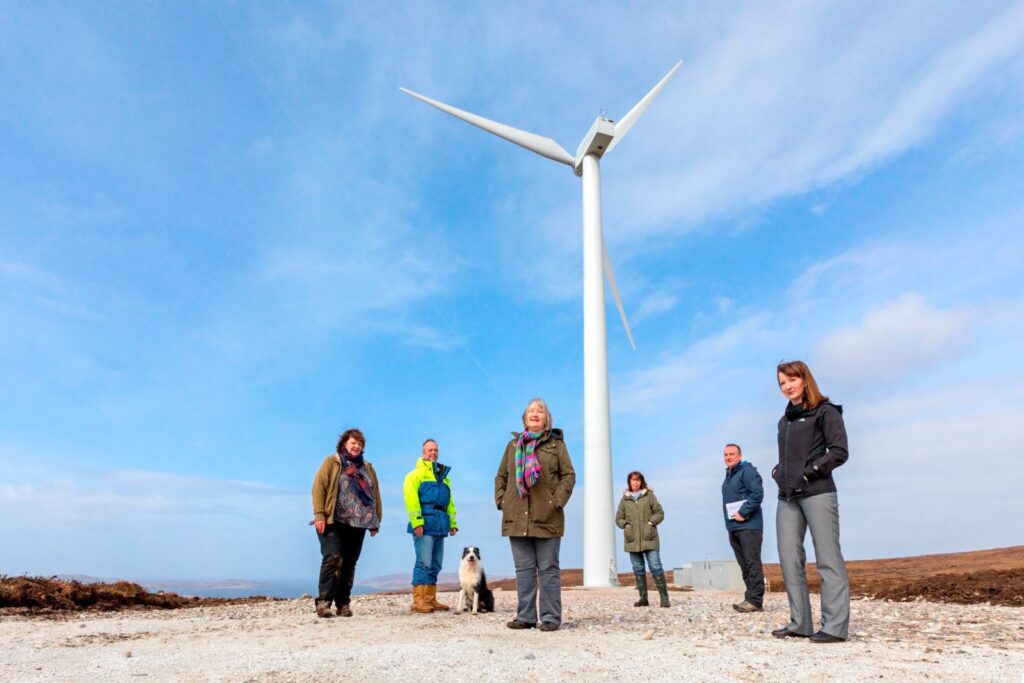

A recent report from the Centre for Local Economies (CLES) puts paid to the idea that there isn’t enough money from onshore wind to go around. The report shows that between 2019 and 2024 Scotland’s onshore wind sector made approximately £5.6 billion in post-tax profits, with £4.1 billion (73%) of that estimated to have been paid in dividends to corporate shareholders. £729 million of that was paid directly to companies owned by private equity or based in tax havens. Scotland’s renewable wealth is being extracted from our economy rather than being recirculated or reinvested in our communities.
Another key finding from the CLES report importantly underlines the need for further land reform to diversify the pattern and concentration of landownership in Scotland. It shows that a major beneficiary of onshore windfarms are private landowners. Landowner rental income over the same five-year period was estimated to be in the £190 million to £380 million, with nearly 90% of this going directly to private companies, individuals, and trusts. These rental payments are equivalent to approximately 7% of onshore wind dividends.
In contrast, the report estimates community benefit payments from 261 operation windfarms were only in the region of £3,167 per MW per year, totalling £147 million over the same period. Equivalent to 3.6% of onshore wind dividends – almost half that paid in rents to landowners. Clearly, Scottish Government guidance alone is not enough for commercial developers to do the decent thing, if it was these payments would have totalled around £238 million, or 5.7% of dividends. This simply isn’t good enough. Community Land Scotland as part of the Scottish Community Coalition on Energy has called for index-linked community benefit payments, which would now be £7,930 per MW per year. The Highlands Social Value Charter has gone even further and proposed community benefit payments of £12,500 per MW per year.
As welcome as increased community benefit payments would be, the report clearly demonstrates that the wealth generated by onshore windfarms is best delivered to communities when they own them. Data provided by four community-owned windfarms in Scotland over the most recent three-year period showed community payments of £10.2 million, equivalent to £261,723 per MW per year. This is nearly 83 times higher than the status quo. If a far greater portion of the onshore wind sector was community owned think of the economic benefits, and related social and cultural benefits, that would cascade out of this.

In community ownership that money is reinvested into the economy; supporting public services, businesses, housing, and jobs, strengthening culture, building thriving communities and a sustainable future. This research report throws into sharp relief the missed opportunity in Scotland’s renewables transition to drive local economic regeneration and community wealth building.
Scotland can maximise the returns and impacts from its renewable energy potential by empowering our communities. Doing so requires the Scottish Government to commit to further supporting communities to take ownership of onshore renewables and prioritise community energy projects on public land. Fundamentally, it also requires a commitment to continuing Scotland’s land reform journey and creating even more opportunities for community ownership of land and assets.
Read the full report below.
This research was conducted by the Centre for Local Economies, funded by Uplift and supported by a steering group of Community Land Scotland, Community Energy Scotland and Uplift.
If you would like to get in touch please see contact details below:
- josh@communityland.scot
- 07940993555