Assynt Foundation’s approach to natural capital has developed around two main strands: partnership-led woodland creation and in-house peatland restoration.
Woodland Creation Partnership
Woodland creation has been delivered through a long-term partnership with the Woodland Trust. Recognising the limits of internal capacity, the Foundation worked with the Woodland Trust to access technical expertise, funding and market connections. Native woodland has been established across multiple sites, with the land for the planting sites leased to the Woodland Trust, who lead on delivery and grant funding applications. Carbon revenues are shared, with early returns guaranteed to provide a degree of financial certainty .
This partnership has since evolved into a more structured, landscape-scale model involving private investment. Through a 30-year agreement with the Woodland Trust, backed with carbon funding by Aviva, woodland creation and wider habitat restoration are being delivered across the Glencanisp and Drumrunie estates. The programme includes the creation of 2,000 to 2,500 of new native woodland in the first phase, alongside restoration of peatlands, riparian areas and fragments of Atlantic rainforest, forming part of a wider 30-year landscape recovery plan.
Peatland Restoration and Commercial Restructuring
In parallel, the Foundation has developed its own peatland restoration projects[LM3.1][RW3.2]. Supported by Peatland Action and working with specialist intermediaries such as Forest Carbon, this strand has allowed the organisation to take a more direct role in delivery while accessing carbon markets.
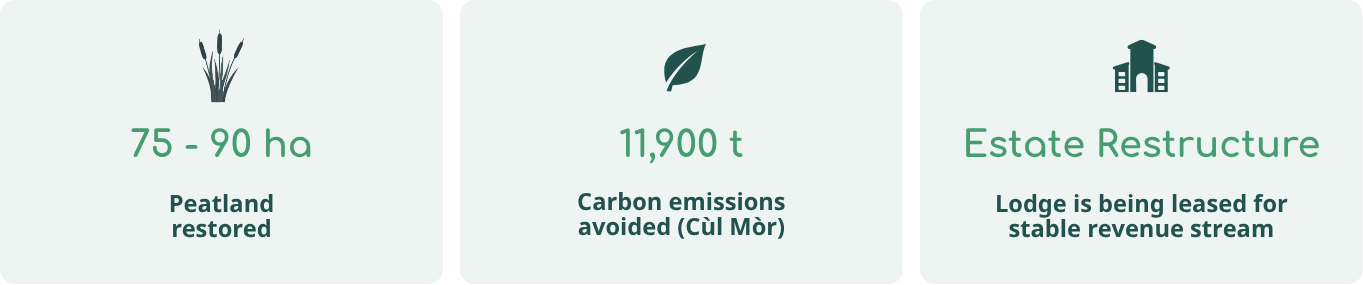
The Cùl Mòr project provides a clear example. Covering approximately 75 to 90 hectares within a nationally designated landscape, restoration works included ditch blocking, hag re-profiling and re-vegetation to raise the water table and enable peat-forming vegetation to recover. The project is expected to avoid around 11,900 tonnes of carbon emissions over its lifetime while also improving water quality and biodiversity.
Importantly, partners such as Forest Carbon supported the Foundation not only with technical design and Peatland Code validation, but also with carbon modelling, upfront finance and access to buyers. This enabled early cashflow through the sale of Pending Issuance Units, helping to bridge funding gaps during project development.
Alongside these nature-based activities, the Foundation has also restructured its existing estate operations. The lodge has been leased to an external hotel operator, providing a stable and predictable income stream that complements the longer-term returns from natural capital.