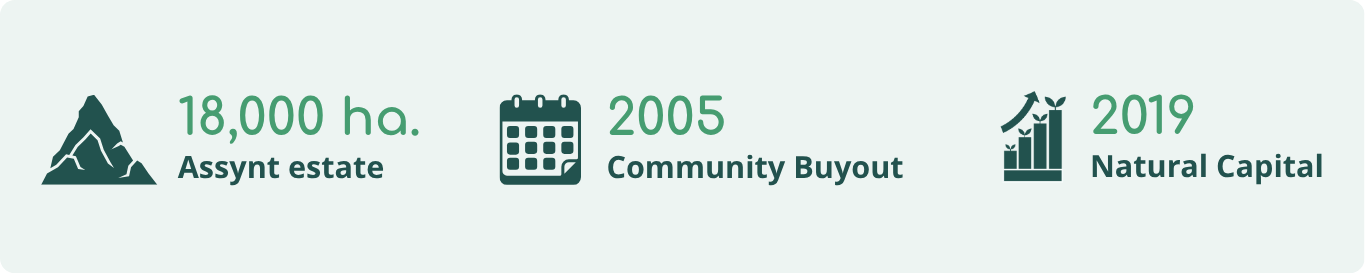
Assynt Foundation land was acquired through a community buyout in 2005 and comprises approximately 18,000 hectares of mountain, moorland, and water, with little agricultural activity. The Foundation operates as a company limited by guarantee and a registered charity, placing community governance at the centre of decision-making.
Historically, income was generated through traditional lodge letting and a deer stalking operation. The hope was to create a community run highland deer stalking estate model. But limited profits, and the cost of lodge renovation and interest payments led to difficult financial conditions.
Early efforts to diversify income through wind and hydro power projects were unsuccessful. By 2017, the organisation was facing a severe financial shortfall and was informed that grant funding would no longer be available, prompting a fundamental shift in approach to land management and income generation. Other Foundation and community activities had demonstrated capacity and given some confidence.
The Coigach/Assynt Living Landscape project and other endeavours led to significant achievements, such as the arts studio, barn, pathways, deer larder and relationship with the Woodland Trust, creating an atmosphere of collaboration and facilitating cross-organisational working.
From 2019 onwards, the Foundation began to reposition itself around natural capital opportunities, particularly woodland creation and peatland restoration, as a route to long-term financial sustainability and environmental enhancement.