The uneasy absence of communities
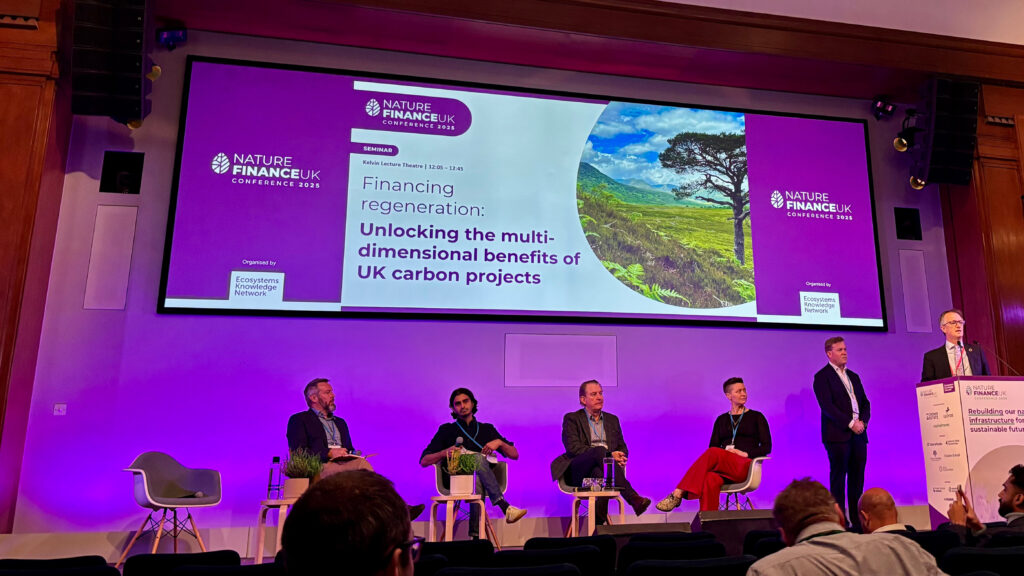
One of the most striking things about the conference wasn’t what was said, but largely what wasn’t.
For most of the day (with a very small number of notable exceptions) communities barely featured in the discussion. That felt notable given that many of the projects underpinning the UK’s nature finance ambitions are located in rural places with a history of exploitation by external interests, particularly in Scotland. When community impacts were finally raised in a closing question from the floor, the response from the room, and the panel was overwhelmingly positive. This suggests the absence of community discussion was not due to lack of interest, but perhaps a lack of awareness of the issues.
The tension between capital efficiency and a just transition sat beneath much of the conversation. Nature finance is largely structured to minimise inputs and maximise outputs – whether timber, carbon or biodiversity units – rather than to create jobs and wider benefits. As projects become more technologically efficient, with greater reliance on remote sensing and low-touch management, the number of local employment and economic opportunities may decline. This sits uneasily with claims about investment in rural areas, and is a tension the sector will need to confront directly if nature finance is to scale with legitimacy.
From corporate social responsibility to business resilience
A strong and consistent message was that corporate engagement with nature is increasingly driven by business resilience, not altruism.
There is growing interest in ecosystem service projects that link directly to supply chains, particularly in food and drink. Examples discussed included regenerative agriculture for barley supply, water quality improvements, and natural flood and drought mitigation. For businesses, investing in nature is becoming a way to protect future production and manage operational risk. Several speakers highlighted a shift towards value-chain investment, where companies back projects connected to their own sourcing rather than purchasing generic credits elsewhere. This feels like an important signal for where more durable demand may emerge.
Co-benefits, resilience and what gets priced
Another recurring theme was the importance of what are often called co-benefits – though many argued this framing undersells their significance.
There was a clear preference for thinking in terms of resilience indicators: community benefits, governance quality, integrity, and wider environmental outcomes that make projects more robust and investable over the long term.
Large investors remain cautious, and the risk of investing in natural capital is still perceived as high. However, several speakers noted that where projects can demonstrate quality, integrity, and community inclusion – for example through ratings or labels – credits are commanding higher prices in global markets (more so than in the UK). While achieving these standards has a cost, serious investors appear willing to pay for the confidence they offer.
A market that barely exists – for now
Despite optimism, there was notable candour about the current state of nature markets. More than one speaker remarked that there is very little transaction volume, even in relatively established voluntary carbon markets.
At the same time, many pointed to a looming demand gap. A large number of companies have 2035-2040 net-zero targets, yet very few have bought meaningful volumes of credits. If integrity and supply issues can be addressed, this mismatch could soon accelerate growth. Schemes such as CORSIA (Carbon Offsetting and Reduction Scheme for International Aviation) for aviation may also accelerate demand more quickly.
For now, however, the challenge is alignment: buyers, investors, projects and standards exist, but they are not yet moving in step.
Scotland at the centre, communities and the need for simplicity
From my count of the day, around half of the projects referenced during the conference were based in Scotland. With London (along with Singapore) being seen as the key global nature finance hub, Scotland is clearly seen as central to the UK opportunity. This raises important questions about who benefits and who bears risk.
A final, recurring point was the need for simplification and consistency. Understanding complex nature projects currently requires deep specialist knowledge. That is not a role investors want, nor should they need to play. If private investment in nature is to grow, developers and landowners must listen more closely to demand and find ways to present clear, comparable, quantitative information on risk, returns, and other benefits.
Conclusion: aligning investment, nature and community benefit
My main takeaway from the conference was that nature finance is still taking shape. No one has it fully figured out yet – even those with teams of analysts and billions in capital. That said, the direction of travel is clearer than it was. Despite significant economic and political headwinds, investment in nature has proven resilient and continues to grow steadily from a low base.
Whether this momentum delivers lasting environmental and community value will depend on how well these different perspectives are aligned in practice. In particular, greater effort is needed to help investors recognise the value of community benefit – not as an add-on, but as something that can drive better outcomes, higher integrity, and more effective delivery, including the social licence required to operate in and benefit from these landscapes. Alongside this, there is a clear role for legislation and policy to ensure that communities are not left behind as nature finance continues to scale.
In my work at NCCP, the focus is on making this real on the ground. Our aim is to bridge these worlds and make sure that community benefit is embedded at the heart of how nature finance develops in Scotland.